NGC 2404
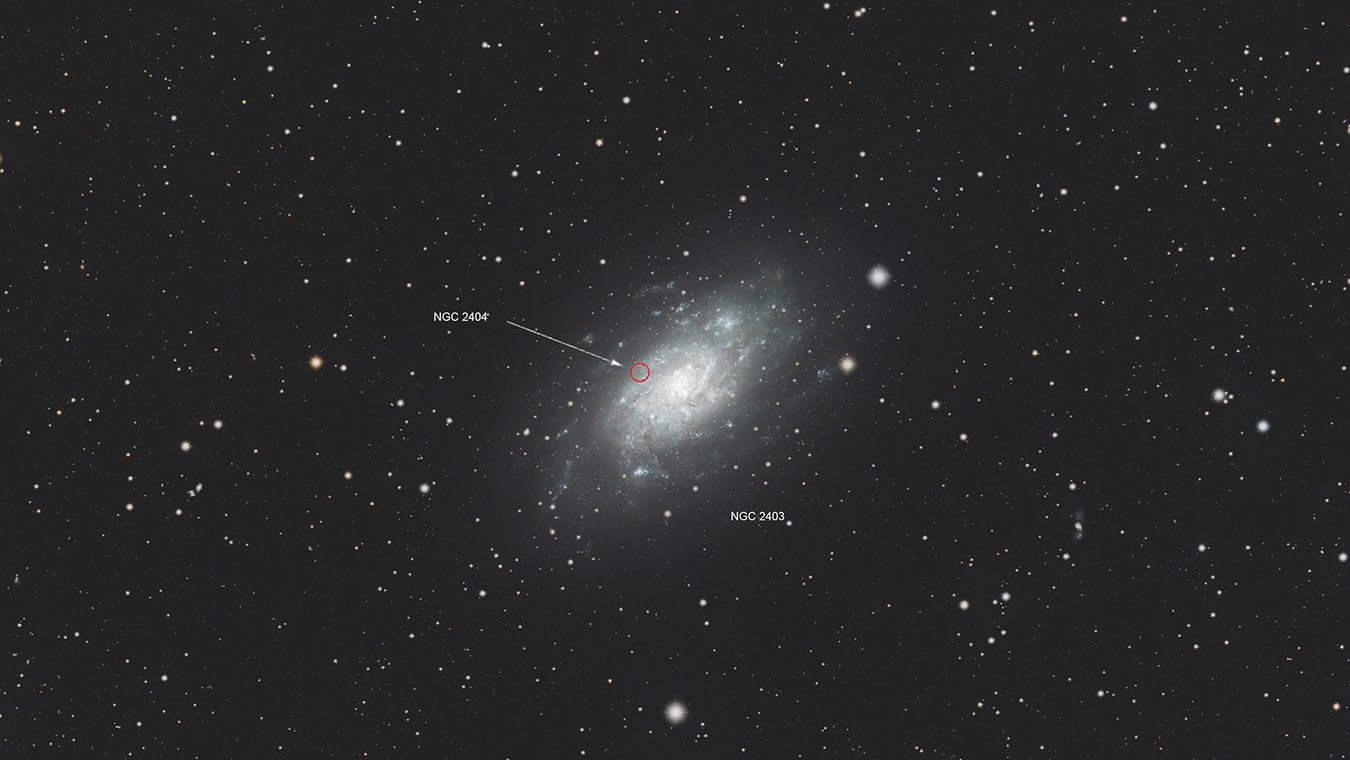
NGC 2404 is a giant HII region located within the spiral galaxy NGC 2403 in the constellation Camelopardalis.
It is one of the largest and brightest star‑forming complexes in NGC 2403, comparable in scale to massive nebulae found in the Local Group.
The region contains numerous young, hot stars whose intense ultraviolet radiation ionizes the surrounding hydrogen gas, producing strong H‑alpha emission.
Deep imaging reveals clusters of newly formed stars, glowing gas clouds, and intricate dust structures shaped by stellar winds and radiation.
Although NGC 2404 is part of NGC 2403, it is catalogued as a separate object due to its exceptional brightness and size.
After several days of snow, the sky is now clear and deep blue during the day. Daytime temperatures are around four degrees. By 17:00 it starts to freeze, and at 06:00 the temperature has dropped to –7.5 °C. The forecast for the nights of 17–18 and 18–19 February is favourable. This is the first time I started an imaging session at 19:45 in the evening, with the final sub downloading at 06:00 the next morning. Before the session, I cleared the snow from the observatory and used a few buckets of warm water to remove the remaining snow from the dome. Because the target is circumpolar, I did not need to go outside often to rotate the dome. (At that time I did not yet have dome control.) The Moon rises at 24:00 on the 17th, and one hour later on the 18th. Until moonrise, I captured NGC 2403/04 in LRGB.
After several days of snow, the sky is now clear and deep blue during the day. Daytime temperatures are around four degrees. By 17:00 it starts to freeze, and at 06:00 the temperature has dropped to –7.5 °C. The forecast for the nights of 17–18 and 18–19 February is favourable. This is the first time I started an imaging session at 19:45 in the evening, with the final sub downloading at 06:00 the next morning. Before the session, I cleared the snow from the observatory and used a few buckets of warm water to remove the remaining snow from the dome. Because the target is circumpolar, I did not need to go outside often to rotate the dome. (At that time I did not yet have dome control.) The Moon rises at 24:00 on the 17th, and one hour later on the 18th. Until moonrise, I captured NGC 2403/04 in LRGB.
Object Data
NGC:NGC 2404
Type:HII region (in NGC2403)
Constellation:Camelopardalis
Distance:~12 million light-years
Observation Data
Location:Pollux Observatory, Zuidlaren
Date:2025-02-18
Technical Data
Exposure time:L- 46 x 180 sec
R- 337x 180 sec
G- 31 x 180 sec
B- 38 x 180 sec
Total: 22.6 h
R- 337x 180 sec
G- 31 x 180 sec
B- 38 x 180 sec
Total: 22.6 h
Telescope:Takahashi FSQ106 ED
Camera:ZWO ASI 1600mm Pro
Color palette:LRGB
Filters:Astronomik 6 nm